How to Wash Pillows Without That Damp Smell

You know that moment you change the pillowcase and think, “Why does this still smell a bit… off?” If you wash pillows but they dry slowly in a London flat, they can end up musty, clumpy, and honestly worse than before. Sweat, skincare, damp air, and tiny washers all team up against you.
Here’s the practical bit: what you can safely do at home, what you shouldn’t even try, and how to dry them properly so they don’t stay damp and funky.
The pillow problem most of us ignore
Most people treat pillows like they’re self-cleaning because they’re hidden under a fresh case. They’re not, and if you rarely wash pillows, all that night sweat, hair products, makeup, and skin oils soak in, then dust builds up over weeks.
This matters if you wake up congested, your skin flares, or you’re just fed up of that “old bedding” smell. According to the NHS, reducing house dust mite exposure includes washing bedding hot (often 60°C where the fabric allows) to help manage allergy symptoms (NHS dust mite advice). Asthma + Lung UK also pushes regular bedding washing as part of reducing indoor triggers for asthma and allergies (Asthma + Lung UK allergy triggers).
We’re going to keep this London-flat realistic: small machines, limited drying space, and the very real risk of pillows staying damp in the middle.

Check the label and fill first
Before you wash pillows, the fastest way to ruin one is guessing the fill. Labels look like hieroglyphics, but you only need three things: max wash temperature, whether tumble drying is allowed, and any “do not wash” symbol.
Do a 20-second pillow check before anything else:
- Look for tears or loose seams, wet filling escaping in the wash is a nightmare.
- If it’s badly yellowed or smells even when dry, cleaning might not fix it.
- If it’s gone flat and lumpy, you’re past cleaning and into replacing.
Fill type is the deal-breaker. Down and feather usually handle machine washing with care. Synthetic is the easiest. Memory foam, latex, and buckwheat should not go in the washer, they hold water and break down.
Common mistakes that cause stink
If you’ve ever tried to wash pillows and they came out “clean” but smelled like wet dog two days later, you’re not alone. The sector has been moving towards gentler detergents and lower-temp cycles, but pillows are one of the few items where rinse quality and drying time matter more than the wash itself.
Here’s what most people get wrong (we see it all the time at the counter):
- Using too much detergent, which sits in the fill and never rinses fully.
- Spinning too hard, which twists the fill into clumps.
- Air-drying indoors with poor airflow, so the core stays damp.
- Storing them “almost dry”, mildew loves “almost”.
If you’ve got that persistent musty odour already, it’s the same problem as damp clothes. The fixes in our piece on getting rid of musty smells apply here too: airflow, proper drying, and not masking it with fragrance.
How to wash pillows in a machine
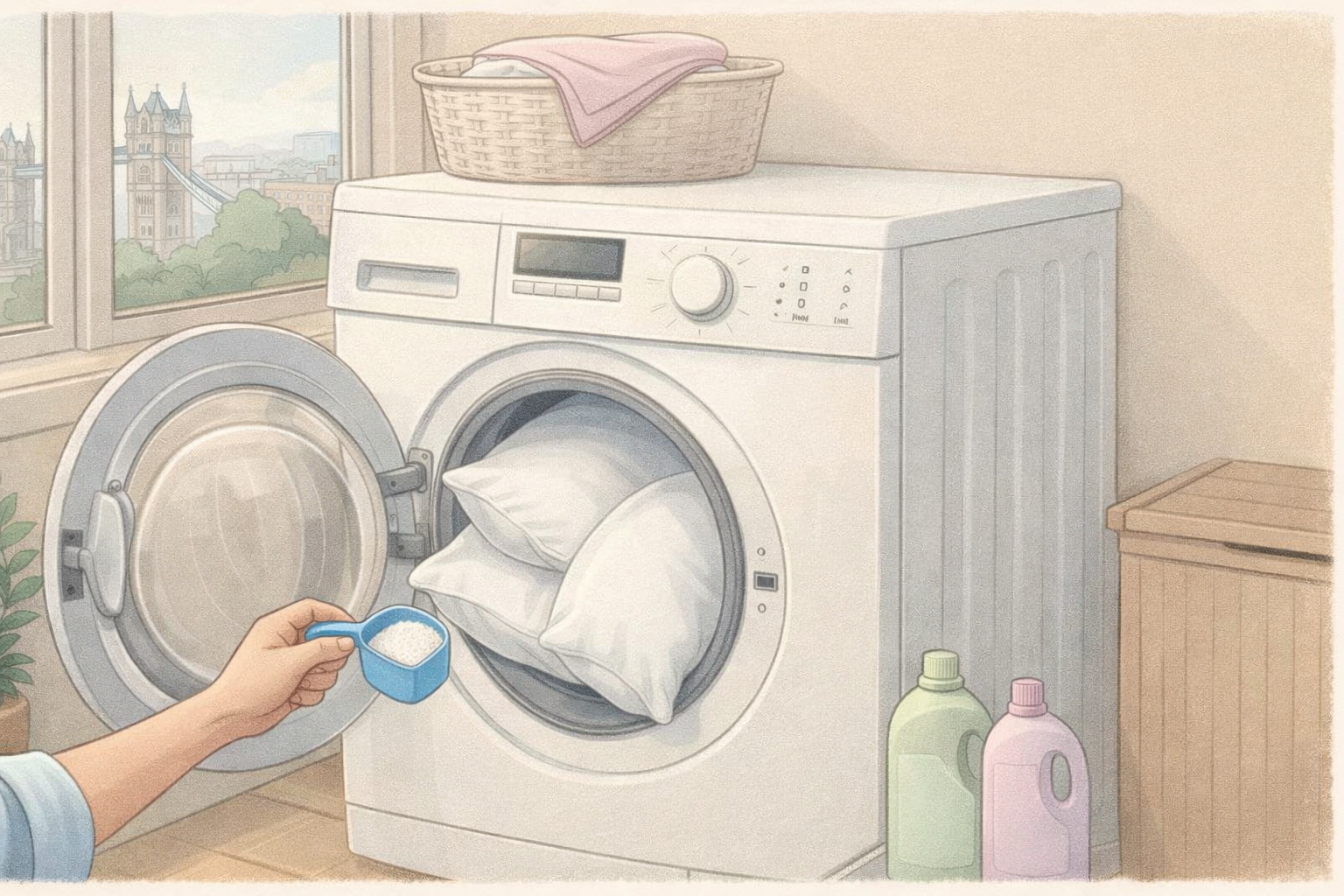
You can absolutely wash pillows at home if your washer is big enough and the label allows it. The goal is to clean the outer fabric and rinse the fill properly, without turning it into a brick.
Use this step-by-step:
- Remove pillowcases and protectors, then check seams.
- Pre-treat marks with a small dab of liquid detergent, especially makeup and drool patches.
- Wash two pillows together if you can, it balances the drum and reduces banging.
- Choose a gentle cycle, warm water (or 60°C only if the label allows), and add an extra rinse.
- Use less detergent than you think, about half your normal dose. Skip fabric softener.
If you’re cleaning pillows in a tiny 5 to 7 kg machine, don’t cram them. Overloading stops proper agitation and rinsing, which is exactly how you end up with detergent trapped inside.
Dry pillows properly (don’t rush it)
After you wash pillows, the “clean” part is easy. The drying is where pillows live or die. Slightly damp is not fine, it’s the start of mildew and that sour smell that comes back as soon as your head warms it up.
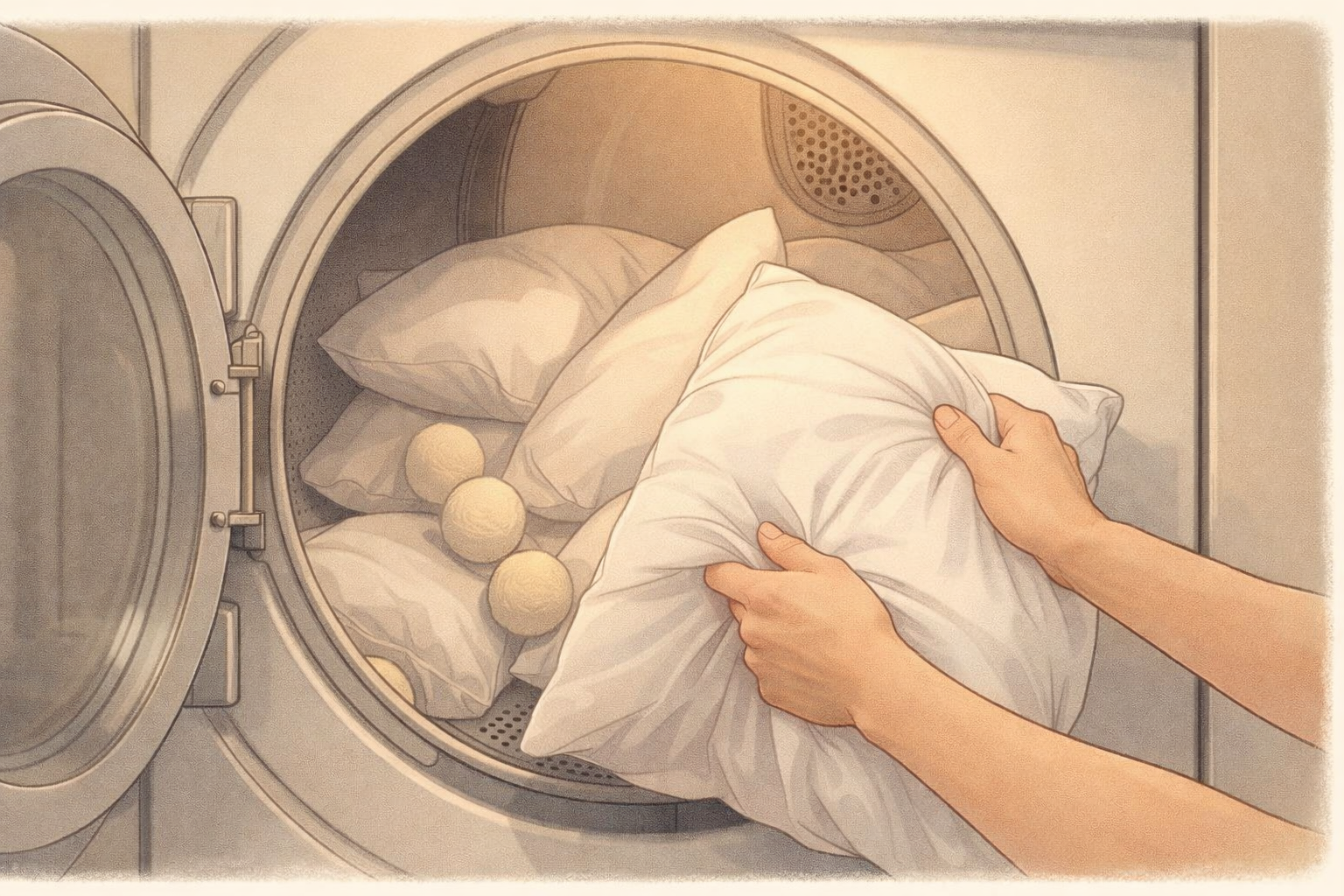
If you’ve got a tumble dryer, low heat wins. High heat can scorch synthetic fibres and damage down clusters. Add dryer balls or clean tennis balls to keep fill moving, then do a stop-and-fluff routine: 20 to 30 minutes, take them out, break up clumps by hand, then back in.
No tumble dryer in your flat? You can still dry them after you wash pillows, but you need discipline:
- Stand them on edge near a window or fan, not flat on a rack.
- Turn and punch-fluff every 60 to 90 minutes.
- Expect 24 to 48 hours depending on humidity.
Insider tip: if the outside feels dry after a day but the pillow still feels cool in the middle, it’s not done. Cool usually means damp.
Pillow types: do’s and don’ts
When you wash pillows, the fill decides what’s safe. Some fills behave nicely. Others act like sponges.
Down and feather: You can wash feather pillows in the machine if the label allows it. Use gentle wash, extra rinse, and plan for a long dry. Clumping is normal mid-dry, you fix it by breaking clumps up and continuing on low heat.
Synthetic/polyester: You can wash polyester pillows fairly easily. They dry quicker than down, but they still hold water in the core. Don’t take shortcuts on drying time.
Memory foam/latex/buckwheat: Don’t machine wash. Water gets trapped and the structure breaks down. Spot-clean instead using a lightly damp cloth with mild detergent, then blot. For odour, sprinkle bicarbonate of soda, leave it for a few hours, then vacuum thoroughly.
If you’re unsure, err on the cautious side. One wrong cycle can turn a decent pillow into a permanently lumpy one.
How often should you wash pillows?
If you’re busy, you need a schedule you’ll actually stick to. If you wash pillows on a predictable routine (and keep protectors in rotation), you get the hygiene benefits without turning it into a monthly ordeal.
A simple routine:
- Pillowcases: weekly, more if you’ve got acne, night sweats, or heavy skincare.
- Protectors: every 2 to 4 weeks.
- Pillows: every 3 to 6 months, depending on use and allergies.
Sleep Foundation guidance on bedding care commonly lands around washing pillows a few times per year and replacing them roughly every 1 to 2 years, depending on fill and condition (Sleep Foundation pillow care). If yours stays flat, smells after cleaning, or triggers sneezing, replacement is often cheaper than endless re-washing.
Now that you’ve got the frequency sorted, the next question is whether your flat setup can actually dry them properly.
When a launderette is the smart move
If you wash pillows in London, the wash part is rarely the problem. Drying space is. If you can’t dry the core quickly, you risk that damp smell returning, especially in winter.
It’s usually easier to bring pillows in if:
- You’ve got king-size pillows or bulky feather ones.
- Your washer is small and struggles to rinse properly.
- You don’t have a tumble dryer, or your building is humid.
- You’ve tried before and the smell came back.
When you drop them off, ask for a gentle wash, extra rinse, and a proper dry on low heat. That last bit matters. A good launderette setup dries evenly, which is the difference between “fresh” and “funky by Tuesday”.
If you’re nearby, we handle this every week at Glint Express in North Finchley and Notting Hill. We can clean and dry your pillows thoroughly, and keep the fill fluffy rather than crushed.
For a broader look at what we do (and what’s best handled professionally), see our laundry service in London page.
If you are dealing with bulky household items alongside pillows, our guide to washing duvets is a useful next step.
Frequently asked questions
Can you wash pillows in the washing machine?
Yes, if the care label allows it and the fill is suitable (synthetic, down, or feather). Use a gentle cycle, warm water unless the label permits 60°C, minimal detergent, and always add an extra rinse.
How do I dry pillows properly if I don’t have a tumble dryer?
After you wash pillows, air-dry with aggressive airflow. Stand pillows on edge, turn them every 60 to 90 minutes, and give them 24 to 48 hours. If the middle feels cool, keep drying. A fan near an open window helps more than a radiator.
Can you wash memory foam pillows?
Don’t. Memory foam holds water and can break down. Spot-clean with a lightly damp cloth and mild detergent, then blot dry. Use bicarbonate of soda for odours and vacuum it off.
How often should you wash pillows and pillow protectors?
Aim to wash pillows every 3 to 6 months, pillowcases weekly, and protectors every 2 to 4 weeks. If you’ve got allergies, pets, kids, or heavy night sweats, shorten the cycle.
Why do my pillows smell after washing and how do I fix it?
They usually stayed damp in the core, or detergent didn’t rinse out. Rewash on a gentle cycle with less detergent and an extra rinse, then dry fully on low heat. If you can’t dry them quickly at home, a launderette dryer is the fix.
Ready for fresh pillows again?
If you’ve been trying to wash pillows at home and they keep coming out lumpy or a bit sour, don’t beat yourself up. In most London flats, the drying stage is the real bottleneck. Use the gentle wash, extra rinse, low detergent approach, then commit to a proper dry (tumble dryer on low heat, or a strict air-dry routine).
Want us to take it off your hands? Pop into Glint Express and we’ll get them properly cleaned and fully dried so they stay fresh.
North Finchley: 9 Halliwick Court Parade, Woodhouse Road, London N12 0NB | 020 3376 2060 | nfinchley@glintexpress.co.uk
Notting Hill: 341 Ladbroke Grove, London W10 6HA | 0745 030 2088 | NottingHill@glintexpress.co.uk